


Walmart’s partnership with ChatGPT marks a turning point in ecommerce. By enabling customers to find and purchase products directly through AI – including “Instant Checkout” – Walmart is signaling a major transformation:
AI is no longer just a tool. It is becoming a commerce channel.
For sellers, especially on Walmart, this shift brings both opportunity and urgency. Here’s what this change means and how you can stay ahead.
AI – The Future Shopping Gateway
With Walmart enabling Instant Checkout through ChatGPT, AI agents are now stepping in as the first point of discovery and the final point of purchase.
The traditional flow – search → click → product page → cart → checkout — is quickly disappearing and shoppers may never land on your marketplace listing. Instead, ChatGPT will understand intent, compare options, and complete purchases on behalf of the customer.
This means your product’s visibility increasingly depends on:
-
- The quality of your data
-
- The clarity of your content
-
- How well AI can interpret your brand
If your listings aren’t AI-optimized, you risk being deprioritized or replaced by alternatives.
“Agentic Commerce” Is Officially Here
Walmart calls this shift agentic commerce where AI doesn’t wait for customers to search – it predicts what they need.
This fundamentally changes the role of brand content.
Your brand voice, credibility, and storytelling must now exist inside AI systems, not just on product pages.
Static listings won’t be enough and AI will decide:
-
- What products to surface
-
- How they’re compared
-
- Which brand best matches the shopper’s intent
How This Impacts Brands: Key Risks & Opportunities
1. Margins & Brand Control at Risk
If AI platforms own the shopping interface, they influence how your products are positioned, which alternatives are recommended, and what margin cuts apply.
2. Speed = Visibility
AI compares products in milliseconds.
Your pricing, content, and inventory must stay updated – or you risk being replaced by “better-matched” alternatives.
3. Trust Becomes a Differentiator
Without traditional browsing, buyers rely heavily on:
-
- Reviews
-
- Authenticity signals
-
- Guarantees
-
- Brand reputation
… which in turn will influence your rankings.
4. Data Will Shift to AI Platforms
The owner of the AI interface (OpenAI, Walmart, Google) may control your shopper data and could limit access to search data, intent signals, and customer journey touchpoints.
This means brands need new ways to understand what drives sales inside AI ecosystems.
5. Smaller Brands Can Win — If They’re AI-Ready
Optimization becomes the new battleground.
AI opens up space for challenger brands, but only if:
-
- Content is high-quality
-
- Metadata is structured
-
- Differentiation is clear
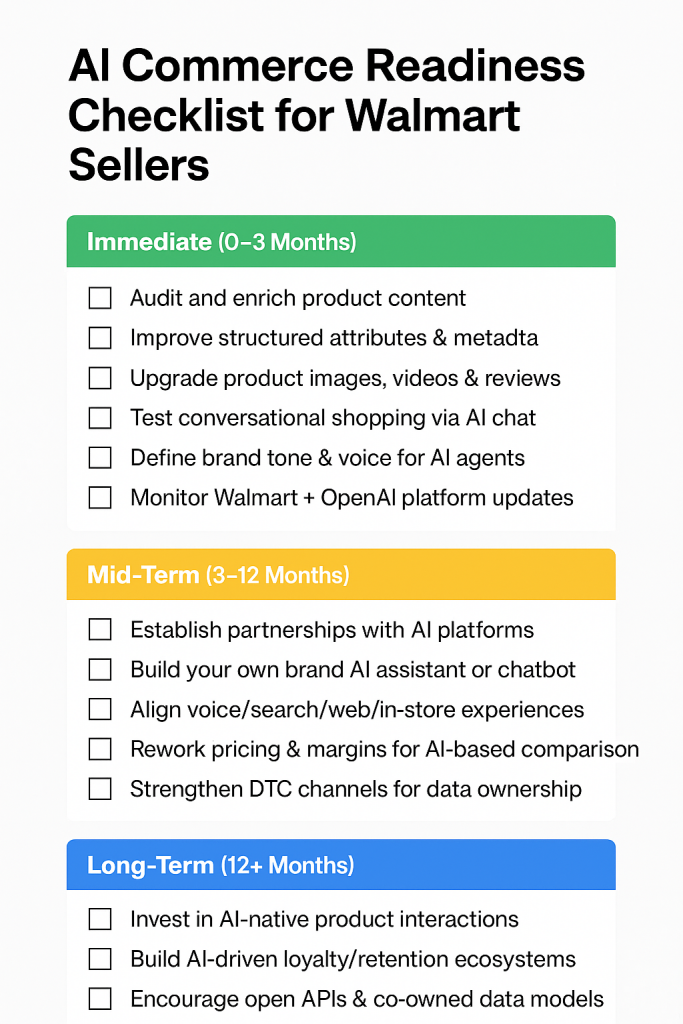
What Brands Should Do Now, Soon, and Later: A Roadmap
A simple checklist for Walmart and Amazon sellers navigating AI-first commerce.
How Optiwise.ai Will Support Brands in This New AI-First Commerce Era
At Optiwise.ai, we’re building the foundation for AI Optimization (AIO) – to help brands thrive as shopping moves into AI-driven environments.
Here’s how we plan to support brands:
1. AI Readiness Assessment
We audit your content, metadata, brand voice, and data setup to identify what’s missing for AI agent visibility.
2. Conversational Commerce Integrations
We enable catalog and checkout connectivity with AI platforms (ChatGPT, marketplace chat systems, etc.).
3. Brand Persona and Voice Design for AI
We help define how your brand “sounds” inside AI systems – ensuring consistency, clarity, and trust.
4. Product Content Optimization
We optimize your listings, images, attributes, reviews, and metadata – so AI ranks you higher and recommends your products more often.
5. AI Performance Analytics
New dashboards to track AI-driven discovery, referrals, and conversion paths.
6. Consumer Preference Modeling
Predictive AI models that help anticipate customer needs, helping AI agents proactively recommend your products.
7. Partnership & Negotiation Support
We guide brands in navigating relationships with AI platforms and securing better data access and visibility.
8. Future-proof R&D
We invest in emerging experiences like voice-first commerce, AR/VR, and smart product ecosystems.
9. Ethics & Transparency Guardrails
We help ensure AI-generated recommendations remain fair, unbiased, and aligned with your brand values.
10. Education & Change Management
Workshops and training to make your marketing, operations, product, and other teams AI-fluent and ready for new ecommerce KPIs.
Final Thoughts
AI-driven commerce is no longer a future concept – it’s already happening.
Walmart’s integration with ChatGPT is one of the clearest signals yet that ecommerce is becoming agentic, conversational, and AI-led.
Brands that adapt early – with strong content, trusted signals, optimized listings, and AI partnerships – will gain a decisive advantage. Those who wait may struggle to stay visible inside systems they don’t control.
At Optiwise.ai, our mission is to help you lead this shift, not react to it.
Ready to future-proof your brand for AI-first commerce?
Talk to Us Here Newsletter