How Content Quality Impacts Ad Spend On Walmart Marketplace
When a product isn’t ranking well on Walmart or an ad campaign isn’t performing, Walmart sellers and suppliers often think the bid is the problem.
But the real issue may start with your product listing content itself.
Strong product content helps Walmart understand your product and match it to relevant shopper searches, improving organic visibility and helping build trust to maximize conversions. However, content alone does not guarantee ad performance. Effective advertising also depends on keyword targeting, campaign structure, bid strategy, budget allocation, and ongoing optimization.
To see how your product listing supports Walmart search and ads, start by looking at its Content Quality Score (CQS).
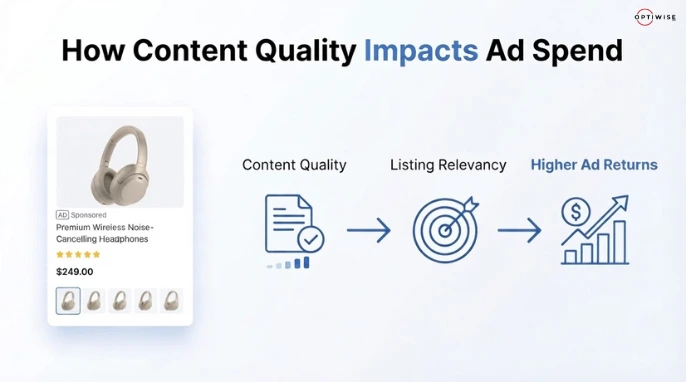
Table of Contents
What Is Content Quality Score (CQS)?
Content Quality Score (CQS) is a metric that measures how clear, complete, relevant, and useful a Walmart product listing is for shoppers and Walmart’s algorithm.
It looks at key elements such as titles, descriptions, key features, relevant keywords, images, and product attributes to determine how effectively the listing communicates information about the product.Score Range:
-
0–49: Low quality, unclear, or incomplete
-
50–79: Good, but has room for improvement
-
80–100: High quality, relevant, and well-structured
Walmart’s Content Quality guidance recommends maximizing an item’s Content Quality Score to at least 80%, noting that this can have a significant impact on overall sales.
A higher CQS provides a stronger foundation for search visibility, relevancy, and shopper conversions.
How CQS Helps Improve Search Relevancy
When shoppers search on Walmart, the platform evaluates product content, taxonomy, and attributes to understand what each product is and how closely it matches the shopper’s search.
Two important elements work together to help Walmart understand and surface your products: content quality and taxonomy.
A. CQS Builds the Foundation for Conversion

A strong Content Quality Score (CQS) helps Walmart understand your product and gives shoppers the key information they need to make a purchase. For example, a listing for a wireless gaming headset should clearly state its product type, connectivity, device compatibility, and main features.
However, content quality is only one part of the shopper’s decision. Reviews, ratings, images, FAQs, and pricing also heavily influence conversion. In fact, a product with a 99% CQS might convert less than one with an 85% CQS if the second product has better reviews, better pictures, or a lower price.
For this reason, sellers and suppliers should focus on the entire product page, not just the CQS. This rule also applies to your search rankings. While CQS is important, Walmart’s algorithm relies on extra signals to rank your product. The algorithm uses backend attributes, customer search terms, and specific details like size, material, or use cases to match your product to relevant searches.
B. Taxonomy Matters for Product Visibility
Taxonomy helps Walmart understand where a product belongs in its catalog. The category, product type, and attributes help connect the product to the right product group and shopper searches.
Think of it like a physical store: a coffee maker belongs in the kitchen appliance section, where shoppers looking for coffee makers can find it. Online, the same principle applies. If a product is placed in the wrong or overly broad category, Walmart may have less context to connect it with the right shopper searches. The right primary shelf gives the search algorithm a clearer signal about what the product is and where it belongs.
Accurate categorization, complete attributes, and optimized content all contribute to a stronger digital shelf and make it easier for shoppers to discover the right products. To learn more, see our guide to Walmart digital shelf optimization.
The same idea applies online:
Optimized content + accurate taxonomy + complete attributes = stronger search relevancy

Driving Ad Success Through Product Listing Optimization
An optimized product listing gives your ad campaigns a strong foundation. When your listing is built around the information and keywords shoppers are searching for, Walmart’s algorithm has more context to understand your product and its relevance to shopper searches.
When you combine a high-quality, relevant listing with the right keyword targeting, campaign structure, and bid strategy, your ads have a stronger opportunity to reach the right shoppers, win auctions at a lower cost, and drive better results.
A simplified way to think about the relationship between bid and relevance is:
Ad Rank = Bid × Relevance
Actual retail media algorithms use additional signals, so this is only a simplified illustration. It shows that bid is not the only factor that can influence ad performance; product relevance also matters.
For example:
Brand A: $2.00 bid × 5 relevance = 10
Brand B: $1.25 bid × 8 relevance = 10
In this simplified example, Brand B achieves the same illustrative ad rank with a lower bid because its higher relevance contributes more to the result. This demonstrates why improving product relevance through listing optimization can potentially help brands use their advertising spend more efficiently.
Optimized Listings + Effective Ad Campaigns = Better Return on Ad Spend (ROAS)
That’s why suppliers should optimize the product listing before simply increasing their ad bids. A stronger listing and a well-structured campaign work together to support more efficient Walmart advertising.
Quick Hacks: Fix Your Walmart Listings
Want to quickly find what’s holding your listings back? Finding gaps in your product listings doesn’t have to be a slow, manual chore. With Optiwise.ai, you can skip the manual work and identify listing gaps and opportunities for improvement all in one place.
You can also download a free listing analysis report to see exactly where your products can improve their CQS, relevancy, and overall listing quality.
Get your insights in just 3 steps:
- Sign Up Free on Optiwise.ai
- Connect your Walmart Catalog
- Get your free product listing analysis report and take instant action

Conclusion
Walmart search and ads perform at their best when the product is thoroughly optimized. Accurate taxonomy, complete attributes, optimized content, and positive shopper signals make your products easier to discover and more likely to convert.
If your Walmart ads are not doing well, do not just raise your bids. First, find and fix the problems in your product listing that stop views and sales. Once that product foundation is strong, you can turn advertising back on to accelerate and scale your sales.
Looking for Dedicated Support ?
Managing a large catalog or building a Walmart advertising strategy can be challenging. Our marketplace and ad experts can help you identify hidden opportunities, prioritize high-impact improvements, and build a stronger growth strategy.
 Newsletter